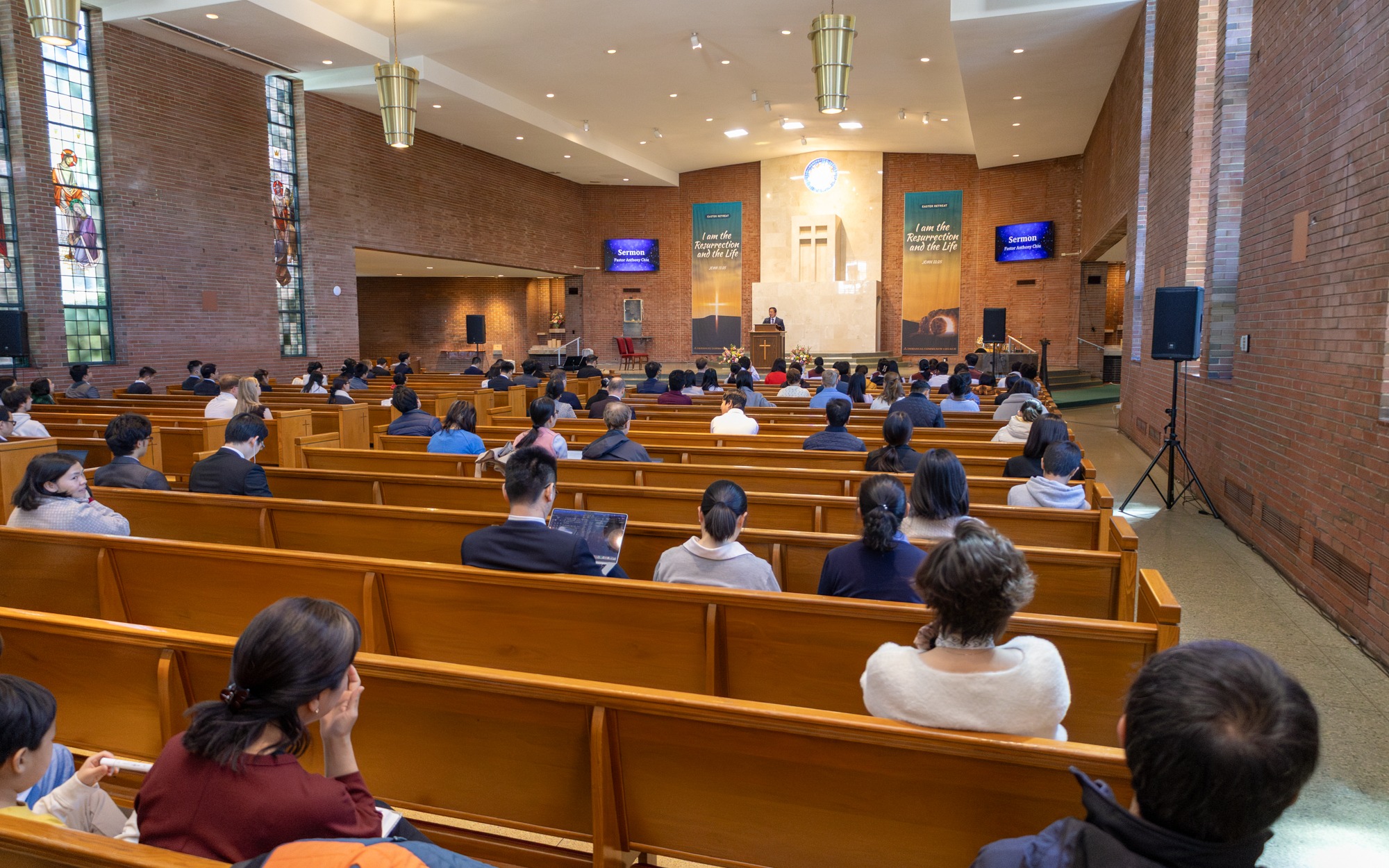
Sermon Manuscript
John 9
A message of hope that God can display His works even through suffering and difficult circumstances.
Public Excerpt
The disciples asked, “Who sinned that he was born blind?” But the Lord answered in a way that opened a new reality. This was not simply a life defined by blame, but a life in which the works of God might be displayed.
God does not waste suffering. Even in the most difficult circumstances, He desires to make His work visible in us.
So that the Works of God Might be Displayed in Him (John 9:1-7)
As we step into this new year, many of us carry a quiet expectation for new life and renewed hope. We hope that something will change—our circumstances, our direction, or perhaps even ourselves. The turning of the calendar awakens in us a longing that the past will not define the future, and that what lies ahead might be different from what has been.
Today, let us consider what it means to receive this new life and new hope, and how God desires to make His work visible in us.
A Man Blind from Birth (John 9:1-2)
The disciples of the Lord asked the Lord a very fundamental question. “Who sinned that he was born blind?” This was a question that so many priests didn’t even think about asking. In the religious leaders’ eyes, it seemed that the disciples of the Lord were unschooled, ordinary people. (Acts 4:13) but they had a deep desire for the truth. They asked the Lord this question with longing that he might have a different interpretation of the miserable reality of life where people are haunted by their fate.
What we should know is that there were so many religious leaders at the time, but no answer was found in them. There were about 20,000 priests who kept the temple at the time, and even more were the teachers of the law who existed. The teachers of the law gave answers to the questions people asked regarding the law, and they interpreted the law. They greatly outnumbered the priests.
However, the answer they would give to this question was predetermined even before asking: It’s his parents who sinned. The answer they gave was that this was all decided before birth. In their eyes, the interpretation of man’s misery was that his parents sinned, and the child carried the consequences.
It seems unfair that you would be punished for something that you did not commit. Yet, the truth is that source of suffering often is not so simple. Thus, you have eastern religions that believe in reincarnation and caste system where the unexplainable sufferings from birth were explained as predetermined fates.
Romans 5:12
Paul, being a teacher of the law once himself, provides his interpretation straight out of the Jewish understanding of where sin originates. Because one man, Adam, who sinned, everyone who came from him thus has fallen into sin. This is what’s called the Original Sin: sin that you did not commit but was passed down to you from the beginning. We see this pattern also from the Ten Commandments, where the Lord God commanded Israelites not to worship other gods, otherwise their children would be punished to the 3rd and 4th generation for their parent’s sin. (Exodus 20:5) Though the difference between Paul and the Jewish teachers is that he found an answer to this dilemma, which we will get to later.
Let’s go back to the disciples who were asking this question to the Lord. Instead of thinking in the traditional way like the teachers of the law did, the disciples asked this question to find a solution to this seemly ageless dilemma from the Lord, “Is it really by fate? But what if it was not by fate?” This shows that the disciples’ level of thinking was higher than the teachers of the law who kept the temple though they were mere fishermen.
What is the faith of the disciples that allowed them to recognize the Lord when the religious leaders of that age did not? It is their desire for the truth and not being satisfied with a continued life under imperfect knowledge. Though there are those who held much higher learning than the disciples, their desire for the truth could not match the disciples, who found being confined to the teachings of the law being problematic. It was their intense desire for the truth that allowed them to meet the Lord, the bearer of the truth.
Isaiah 9:1
Thus, the prophecy became fulfilled, that the Lord would honor the land of Galilee, though they are further from the distance than Zebulun or Naphtali in terms of closeness to Jerusalem, the holy city of God. The salvation of the Lord went to the one who was furthest, which he brought them close by sheer grace because of their faith. (Ephesians 2:12-13) It was such that Paul, despite his great learning, would receive the gospel message spoken by the Lord via the mouth of these apostles and there discover this faith.
Now, let’s return to the question that’s at hand. Why was this man born blind? This is the fundamental question the disciples asked the Lord. Jesus would then provide them an answer that the teachers of the law could not give till now.
So that the Works of God Might be Displayed in Him (John 9:3)
Jesus answered the disciples, and what he said was something quite shocking. Most people judge a person by who he/she is now because of what his/her parents are like or because of what his/her background is like. However, the Lord presented a different view.
Our Lord, the great teacher of the old and new covenant, said, “It was not that this man sinned, or his parents.” And he said the reason was, “So that the works of God might be displayed in him.” Jesus shone this bright light upon those who were trapped in the darkness of despair and fate. Not only that, but he also revealed opened by the era of the gospel to his disciples.
The prophet Isaiah said, “For as the heavens are higher than the earth, so are my ways higher than your ways and my thoughts than your thoughts.” (Isaiah 55:9) Through Jesus, God provided an answer that we could never have understood ourselves.
Jesus said, “So that the works of God might be displayed in him.” This was a revolutionary understanding that requires faith beyond what the law could show us. God can do great things despite a man’s fateful blindness from birth. It is not because he deserved to be punished that he is born, but it’s because God will do great things in his life. A truly amazing answer has been given to us: so that the works of God might be displayed in such a man.
Our despair in life comes from the fact that we cannot see hope past our past and present experiences. It is easy to give in to the concept of fate when that seems to be the easiest answer made available to us. However, the Lord provided us the way out through a world that could only be received by faith: you are not given a life to only worth throwing away for, but a life that God has predestined for something much greater than what you can imagine.
God does not make mistakes. From conception, each of us is brought into this world with purpose. God’s purpose in giving us life is not to cause us suffering, but to accomplish His good work in us. We are predestined in love. Yet the challenges of life often lead us into jealousy, causing us to wonder why God seems to favor others—granting them better backgrounds, greater abilities, or more visible success.
In Mahayana Buddhism, there is an image of a deity depicted with a thousand arms and a thousand eyes. This imagery expresses humanity’s deep longing for a power beyond its own limitations. Even though human beings are created with two arms and two eyes, exactly as designed, people often feel helpless in the face of their circumstances. In that sense, the image reflects a desire for a god who possesses what humans believe they lack—one who can see more, do more, and overcome what they perceive as their own insufficiency.
When we have faith, what we will discover is that our Lord gives us is more than enough to work with. Although God entrusts each person with different gifts and callings, He does not differ in His ultimate purpose for us. We all share the same destiny: to display His glory, grounded in the love with which He has predestined us.
Someone once introduced me to a sermon video by an Australian preacher named Nick Vujicic. I am not sure if you are familiar with him, but the person who shared the video with me was deeply moved by both his message and his life story. Nick was born with tetra-amelia syndrome, a rare condition that caused him to be born without arms and legs. Throughout his life, he faced immense challenges, including bullying, physical limitations, and seasons of deep depression because of his disability.
Humanly speaking, to be born in such a condition might seem to leave little room for hope. Yet Nick encountered the love of God in a way that transformed his life. Through faith, he learned to use what he had—his voice, his testimony, and his lived experience—to bring encouragement and hope to countless people who are struggling with despair and hardship.
Many people listen to Nick because his life is deeply relatable. They come to understand the love of God not merely through his words, but through his very existence. Simply by seeing his life and hearing his testimony, people are convinced that God’s love can be at work even amid profound limitations. His story bears witness to the truth that God’s purposes are not bound by human weakness or by what appears, from the world’s perspective, to be a fate sealed by suffering or death.
2 Corinthians 5:14-17
In Christ, what we have been given is the life of a new creation. One that is not confined by our past knowledge of things and its predictable fate, but rather one that lives in great hope because of our faith in the one who loves us. There is no limit to glory in this life because of Him who predestined us and loved us. It is not the life of despair he has given us, but a life full of miracles when we are willing to believe and follow him by faith.
Galatians 2:20
Paul describes his experience of faith by declaring that his former self died when he was united with Christ in His death on the cross. Through the death of Christ, Paul came to realize the greatness of the love that was willing to sacrifice itself for a sinner like him—one who was undeserving and, by justice, should have died in Christ’s place.
Therefore, the life we live after encountering the cross is no longer a life turned back toward sin, whose wages are death, but a life now lived by faith in the Son of God. It is a life called forward by the Lord Himself—a life in which God, by His grace and victory through the Lord’s resurrection, has purposed and predestined us to display His glory, even through our once-broken and unworthy selves.
Do the Works of Him Who Sent Me (John 9:4-5)
Here the Lord makes a clear declaration about the work that remains to be done. He speaks with urgency, emphasizing that the works of God must be carried out while it is still day. In a similar way, in Matthew 9, when Jesus saw the crowds—harassed, helpless, and afflicted—He instructed His disciples to pray to the Lord of the harvest to send out workers, for the harvest is plentiful but the laborers are few.
The world is filled with those in need of healing: the brokenhearted, those weighed down by despair, and those burdened by sin. Jesus’ words reveal His awareness that much work remains to be done while He is present in the world. His own life bears witness to this calling. He lived with singular devotion to the work of God, grounded in His intimate knowledge of the Father’s love and purpose.
John 4:34
This is the compassion the Lord has for us. Beyond the basic necessities of life, He regarded the work entrusted to Him by the Father as His highest priority—even carrying Him beyond the suffering of the cross. He did not fix His attention on His own pain, but chose instead to bear the weight of ours. Moved by love, He remained faithful and steadfast in accomplishing God’s work in this world, even within the real limitations of His human flesh.
Consider doctors in this world. Their profession is widely regarded as honorable, yet it can also be deeply thankless. Many doctors become risk-averse, not because they lack skill or compassion, but because they have encountered patients who complain even when the doctor has done everything possible. As a result, some physicians begin by explaining the worst-case scenario first, guarding themselves against blame if the outcome falls short of optimistic expectations.
At the same time, those seeking healing often approach doctors with expectations shaped by fear, entitlement, or misplaced blame. When healing does not come as desired, responsibility is quickly assigned to the physician, even when there are pre-existing conditions or disregard for medical guidance. This dynamic creates an atmosphere where hope itself becomes risky. The one whose vocation is to heal begins to speak cautiously, not because healing is no longer the goal, but because the cost of disappointment has become too great.
Yet what we see in Jesus—the great Physician—is One who entrusted everything to the Father and made the ultimate sacrifice to bring us the good news. He stepped into our broken world to heal the sick, even while facing a thankless generation that, in its stubborn refusal to turn from its ways, condemned Him to the cross. Still, He loved us and gave Himself for us, willingly bearing every cost, so that through His healing we might behold the hope God has predestined for us.
Wash in the Pool of Siloam (John 9:6-7)
Is it merely a coincidence that the Lord sent this man to the Pool of Siloam—whose name means “Sent”—to wash and receive his sight? In the moment the Lord heals, He also gives purpose. Healing and sending are never separated in Jesus’ work. Yet how do we understand the Lord’s sending in our own lives? Do we see it only as a command issued by a commander to an army, expecting nothing but blind obedience from us for what we are called for, or do we discern a deeper meaning rooted in His love and intention for us?
Matthew 20:6–7
In this passage, the Lord describes the master of a vineyard who encounters people standing idle in the marketplace. When he asks why they have been standing there all day, they reply, “Because no one has hired us.” They were not unwilling to work; they were simply waiting to be called.
God’s calling flows from love. There is a deep groaning within the human heart—a longing to live out the true purpose of life and to see God’s glory revealed through us. Yet many are already busy in this world. The tragedy is that busyness is not the same as purpose.
In English, we have a term called “busybody.” It describes a life that is outwardly active but inwardly disengaged—physically occupied, yet spiritually empty. It is a life where the hands are busy, but the heart is absent. The pain of such a life lies in its unfulfilled longing: the desire to pour oneself fully into something meaningful and to experience the fullness of glory and purpose that God has predestined for us.
2 Timothy 2:20–21
What, then, is our deepest desire? It is to be used—to be set apart for a holy purpose that gives true definition and meaning to our lives. We long to be instruments in God’s hands, vessels through which His glory is made known.
What is remarkable is that God is willing to work with every kind of vessel. Whether one is made of gold or silver, wood or clay, what matters is willingness to be cleansed. When a person purifies himself, he becomes an instrument set apart for honorable use, ready for every good work. As we humble ourselves, emptying what must be emptied, and making room for what God desires to give, we will witness His work unfolding in us in ways beyond our imagination.
As we enter this year, my prayer is that we would become new people—ready to receive the blessings God desires to give. May our lives display His glory, and may we live each day in praise of the One who loves us beyond measure.
Respond to this message
Need prayer or want to visit us in person? We would be glad to connect with you.